

During 2024 I experienced something that I am still healing from but until now haven’t been able to find a name for. And perhaps that’s why I yet have not been able to speak with anyone about it, because I know from previous experiences how important appropriate names and labels can be when trying to convey something of importance. One morning, going into the shower and without a warning, an insight suddenly dawned on me: ”On a deeply emotional level, I now can understand the vicious dynamics within people who suffer from abusive intimate relationships — and yet deliberatly prefer to remain in them.” This blog post is an attempt to describe some insights from the introspection in regards to suffering, as well as what brought about an autotherapeutic effect on me.
The purpose of this blog post
In my life I have gone through a series of dark nights of the soul, so I feel I have to be clear before moving on: I don’t write and publish this blog post because I want someone out there to feel pity for me. Rather, the quest for this post is to a) acknowledge all of you who may have experienced something similar, and b) by doing so, maybe I can shed some — although probably fragmented — light on the topic through my own story. Simply because I think I may have suffered in a similar way like you have, and potentially also for the same reason in accord with the personalities or egos that have been constructed for or by us.
That being said, though, and in accord with what I elaborate on later in this post, reading this the right way may require the capacity of a certain degree of empathy for other sentient beings. But just as much, it can require an analytical mind to fathom both the motives behind this post as well as the topic per se. I assume that capability may not be feasible for all people, while others have plenty of it, and that may, e.g., have to do with our genetical makeup as well as how well our development into mature beings has been. Not only in regards to the culture we live in, but as human beings on this Earth. Whether you as my reader belongs to this or some other cohort is mainly for you to find out yourself as the reading goes on. Furthermore, it may also require a small portion of familiarity with Myers-Briggs Type Indicator (MBTI) to make sense of it. But in that regard, I’ll do my best to present it as extensively as this blog format allows for — which shouldn’t be too long (haha, I wish! 😉 ).
Moreover, my intention here is not to ”throw somebody under the bus”. Rather, it is about a meaning-making and constructive process that has helped me coming at least partly to terms with the inner turbulence during and after the relationship I experienced in 2024; both from while it lasted as well as its long-lasting emotional aftermath on my behalf.
Introduction
Now, during the first couple of months into my new project I have mainly spent time digging deeply into the personality typology of MBTI; and partly also into the Swiss psychiatrist Carl Gustav Jung’s typology, which underlies MBTI. That soon made me stumble upon descriptions which my intuition obviously but subconsciously collected for future use, and after some days I suddenly experienced a series of spontaneous ideas while doing other things in my daily life than deliberate introspecition. Some of them had a common thread of concern: my previous relationship. So I thought I had to collect these ideas in one way or another; so here I am writing this. 🙂
First, let me introduce you to the world of psychological functions according to the MBTI theory before I return to the mentioned relationship, on which I then make use of the theory.
The building blocks of MBTI
To my mind, the most productive way of learning how to make use of MBTI is to delve into the psychological functions of intuition (N)1, sensing (S), feeling (F), and thinking (T). All four of them come in two versions which are based on their direction of energy (hence libido); an extraverted version (e) and an introverted version (i). Thus, we actually have to wrap our heads around eight rather than just four functions, because the eight ones are the actual building blocks of MBTI.
The dynamics of the building blocks
Hence, if we don’t understand these building blocks reasonably well, we won’t really understand MBTI very much; and therefore we cannot apply the system very much on ourselves either. The very least for self-helping, autotherapeutic purposes. So, finding our type within that system without knowing at least something about the eight functions is quite pointless in my point of view: ultimately we just get ourselves a type that we can somewhat resonate with – and then what?
Now, the functions are not totally isolated from each other, of course. Rather, from a young age they tend to form an amalgam in our psyche.2 Although, the theory claims that during childhood we eventually learn to prefer and therefore rely on one function more than the others, so through a differentiation process it becomes the dominant function. That is actually what the most common MBTI self-assessment questionnaires tend to focus on: to order our functional preferences.
Obviously, as a human creature in this world, we cannot rely entirely on one single function, so the remaining functions have to complete us. Those which are supposed to be the most consciously important in that sense are called the auxialiary, tertiary, and inferior functions, and they in terms of differentation form a more or less balanced mix of perceiving (hence intuition and sensing) and judging (hence feeling and thinking) functions. Moreover, the theory also proposes that those functions’ direction has to alternate in terms of energy for the sake of keeping our personalities reasonably balanced. Thus, is the dominant function extraverted, the auxiliary function is supposed to be introverted, whereas the tertiary function is extraverted just like the dominant function, and the inferior function is introverted like the auxialiary is.
That being said, we should also keep in mind that we are here dealing with the sets of functions which are the most conscious ones. So, out of totally eight available functions, just four of them are supposed to be conscious according to the MBTI theory. The other four are supposed to be unconscious, but that does not mean they are of no use. Instead, they are supposed being rejected parts of ourselves residing in the psychological shadow, which we, e.g., tend to project onto other people without being very much aware of it.
A brief comment on differentiation before continuing
Regarding development through functional differentiation, there is at least one more aspect to emphasize: the issue of functional domination, auxialiarity, tertiarity, and inferiority addresses preferences of the libido which means it does not necessarily tell us anything about how well developed each of these functions is per se. Rather, each function can appear as irrational or rational — or if you will, indirected or directed, active or reactive, productive or consuming, abstract or concrete — in accordance with the degree of development of the subject’s willforce in these functional domains.
Now, development rarely comes spontaneously, which means that all the functions need more or less dedicated training by will to transform from being irrational/indirected/reactive/consuming/concrete to becoming rational/directed/active/productive/abstract. In other words, this may bring hope for anyone who would like to progress into a larger degree of maturity in each function’s area. And by discovering, exploring and integrating the four shadow functions into awareness, they may also add to our growth as human beings.
So, let us now continue with the function stacks, which simply illustrate how the functional preferences are stacked upon each other in regards to their domination in the psyche.
The INFJ and INTP function stacks
In the following we can picture two MBTI types’ functional preferenses like a stack of functions being vertically piled on top of each other, whereas each function also is aligned horizontally along an extraversion/introversion axle. For the sake of the purpose of this blog post while trying to make sense of my relationship in 2024 through an MBTI lense, I choose to illustrate the function stacks of INFJ and INTP types in a simple chart:3
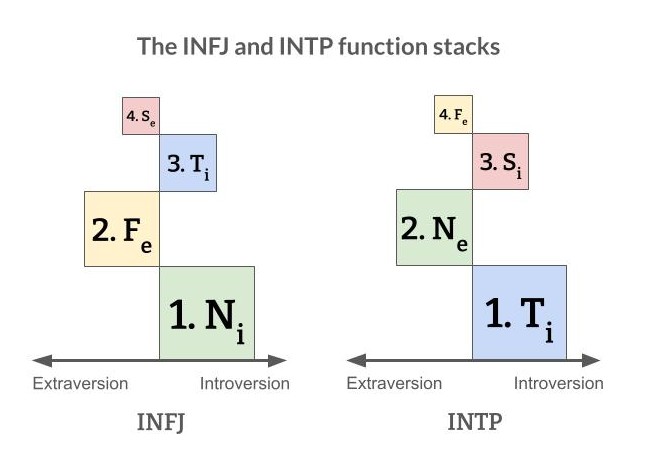
According to the chart, the dominant function of the INFJ is obviously introverted intuition (Ni), whereas the auxiliary function is extraverted feeling (Fe), the tertiary is introverted thinking (Ti), and the inferior function is extraverted sensing (Se). For the INTP part, the dominant function is introverted thinking (Ti), the auxiliary is extraverted intuition (Ne), the tertiary is introverted sensing (Si), and the inferior fourth function is extraverted feeling (Fe).
Obviously we here have a couple with two introverts. In regards to functions, that means that on each level of the function stacks, both types’ functions have the same direction of energy. Moreover, the INFJ and INTP couple share only two of their functions altough on different levels: extraverted feeling (Fe) and introverted thinking (Ti). In other words, here we can expect some functional friction — although potentially benificial in a complementary sense.
A more detailed interpretation of the chart
Since this section turns out to become pretty vast in regard to text space, I decide to hide the content under each subheading below. Thus, by clicking on those subeheadings the content will fold down.
Level 1 (dominant functions):
The INFJ’s perceiving function of introverted intuition (Ni) vs. the INTP’s judging function of introverted thinking (Ti).
So here we can expect the subjective capacity for big picture seeing, constantly pattern- and why-seeking, imaginary, visionary, future oriented, and therefore patient and externally low key part of the INFJ. Whereas on behalf of the INTP, we can expect subjective thinking requiring an inner logic of clarity, concisesivness, precision, consistency, and coherence — also mainly being done in a patient and externally low key way. An optional way to put it, Ti is the dominant function of INTP that creates inner beliefs, which this type to a large degree identify themselves with.
Thus, within this couple, the INFJ may normally serve as the main perceiver, whereas the INTP may normally serve as the main decisive judger. So for example, we can expect the INFJ to quite easliy come up with visionary long term dreams or goals for this couple, whereas the INTP will probably test their logical sense but also implications in order to qualify or disqualify them according to this type’s own internal logic, which for this couple may serve as an inter-subjective reality check of the INFJ’s intuition.
In other words, on this level these two types may meet some challenges since both functions are introverted; thus highly subject-oriented and therefore it may be hard for them to communicate to reach a commonsense. Although, by a getting-to-know-and-trust-each-other process, that may make them come closer to each other by learning how to trust their partner’s dominant qualities: the INFJ suggesting them long-term paths to take as a couple, whereas the INTP deciding which paths to choose while dealing with nitty-gritty details. And while they are at it, the requirements of the INTP’s Ti function may have a grounding effect on the INFJ and may also inspire their tertiary Ti process, whereas the patient and long-term nature of the INFJ’s introverted intuition may have a grounding effect on the INTP’s more spontaneous and therefore short-sighted auxiliary function of extraverted intuition (Ne).
Thus, due to the high degree of dominant introvertedness — i.e. subjectiveness — for this couple, I would like to stress that for their relationship to work out, one of their greatest challange probably is to develop a shared communication framework that well enough suits both of them. Moreover, to really thrive as a couple, they probably have to spend much time together to really get to know each other well enough.
Level 2 (auxialiary functions):
The INFJ’s judging function of extraverted feeling (Fe) vs. the INTP’s perceiving function of extraverted intuition (Ne).
Now, both these extraverted functions of Fe and Ne are mainly what can bring these two types together in a real life setting by bridging their challenges on, e.g., level 1.
By their Fe, we can expect the INFJ serving as this couple’s first hand social connector — as their intersubjective ”people’s person”, within the relationship as well as externally –, because that is the function which, e.g., predominantly contain inter-subjective open-hearted compassion and empathy for other sentient beings as well as being the main facilitator of emotional attachment. As such, the INFJ will probably take the main role of feeling into their INTP partner’s feelings, as well as into people around them; and by doing so the INFJ probably would be the one who foremostly invites people into their shared space. Either in person or as topics to talk about.
Meanwhile, what the INTP brings to the table is the wonderful gift of Ne object-oriented connector towards tangibles, by spontaneously looking for external novelties and opportunities in their immediate surroundings — manifesting as, e.g, adventurous explorations and other kinds of experiences that might challenge their creativity as well as courage, while bringing them a shared excitement and joy in the moment but also shared memories from those events. It may also, e.g., serve as this couple’s main explorer of things to make use of — for example, tools to create other tangible things with. Which obviously may have a refreshing, creative, and productive effect on a long-term relationship between these two types. Potentially that can also affect people around them as well.
Thus, despite this couple’s mainly introverted characteristics, they may become quite an interesting and entertaining couple to spend time and space with!
Level 3 (tertiary functions):
The INFJ’s judging function of introverted thinking (Ti) vs. the INTP’s perceiving function of introverted sensing (Si).
So, on this level their first shared function of Ti occurs for the INFJ part; whereas on behalf of the INTP, their third function is yet another unique function in this couple constellation.
Hence, as its characteristcs already has been described for the INTP above, the Ti function tends to play out in the INFJ as well; although normally not as clear, precise, consistant, and consise under the influence of Ni and Fe. A circumstance that, on the other hand, e.g., may make the INFJ being able to reflect on their own thoughts, consciously hold complexity, different perspectives and even paradoxes quite well in their mind since their selves normally may be less indentified with the requirements of their thinking process. Therefore, the nature of INFJ’s Ti tends to be more hypethetical than being firmly rooted in inner beliefs.
On the INTP’s behalf, the Si percieving function can stand for sensing the inside of the physical body, although as such the body may also serve as the reservoire of sensory based memories from the past. So, just like the introverted intuition of the INFJ may bring inner images of future situations into awareness, Si brings images and other sense perceptions back from past events. As a dominant function of a specific type — such as ISFJ or ISTJ — that could potentially make them, e.g., an exquisite and highly reliable witness in a court case, an artist of realism, or a successful historian of contemporary times. On the other hand, that could also make it hard for them to, e.g., fathom the world of abstract ideas since their main perception inclines toward what is physically real and concrete. In turn, assumingly that tendency may also make their minds quite conservative or even resistant toward change. Although, as for the INTP’s tertiary function, this tendency may not be as prominent under the influence of Ti and especially Ne.
Now, as tertiary functions both Ti and Si normally tend to be rather suppressed for this couple as long as their dominant and auxialiary functions are in order and get stimulated. But at times that may rapidly change, which may be particularly critical for their auxliary extraverted functions, since they are what mainly bring this couple closer to each other. That being said, within the MBTI community there is an oftentimes discussed phenomonen called looping, which addresses such a situation: typical loops occur as the dominant and tertiary functions tend to hijack the psyche because the auxialiary function for some reason has been ”checked out”. Thus, in our case this means that the INFJ’s Ni + Ti functions will primarily take over the show, whereas for the INTP it will be their Ti + Si — two processes which will make both of them highly introverted, and therefore very subjective. Toward the end of this blog post I will elaborate on this topic in regards to the suffering in and after our relationship.
Level 4 (inferior functions):
The INFJ’s perceiving function of extraverted sensing (Se) vs. the INTP’s judging function of extraverted feeling (Fe).
On this fourth and inferior level of conscious functions, the INFJ’s unique perceiving Se and the INTP’s secondly shared judging function of Fe occur. So, while the INFJ turns outward toward objects out there by, e.g., physical touch, sensorimotored kinesthetics, and practical skills to form physical objects; the INTP’s compassion and empathy for other sentient beings sets in. Although, we should not expect them to be highly motivated or constant peak performers in these areas, since these functions normally to a large degree tend to be suppressed under the influence of Ni + Fe + Ti on behalf of the INFJ, and the INTP’s Ti + Ne + Si. Rather, these inferior functions tend to be quite unstable albeit they at times may have sudden although short-lived bright episodes in the conscious limelight.
Of course, that does not mean these types cannot develop and increasingly integrate these functions, just like we potentially can with the shadow functions. In fact, as we mature into an increased adulthood while learning how to accommodate to the world around us — or at least learning how to survive in it under different and changeable circumstances –, we tend to do exactly that simply because that is what may be required from us.
—
Now, this may suffice as an introduction to the MBTI theory for today. With the above in the back of your mind, I now invite you to return to the main topic of this blog post. That being said, below I will directly or indirectly refer to some of the above elementa, but I may not explain those instances very much. There might also be new pieces of elementa, and those I will put in foot notes to keep this post as short as possible. And by the way, I do advice you to click on these foot note indicators and read those foot notes, because they are there for a reason (and you may easily return to the text by clicking on the foot notes trailing ”carriage return” or <ENTER> icon).
Analysing the suffering in an MBTI perspective
As a preface to the analysis, I may divide my suffering into at least two different phases. The first one occurred during the active but mainly online intimate relationship that I had in 2024, whereas the second phase occurred retrospectively due to lots of memories from the relationship as well as from further conversations with my ex-girlfriend after the final breakup. In other words, the suffering has occurred sequentially over two main periods, and their qualities in terms of suffering have been somewhat different. I will return later on to each of these two periods below.
The romantic fool’s last intimate relationship
As a late prologue right in the middle of things, before I met her I was determined to find my last intimate relationship, since my almost 60 y.o. soul told me that I could not waste more time on intimate relationships that in the end just make me miserable. In other words, I felt kind of fed up with looking for a partner and that I should use my energy on more creative ways of living the life I have left. So, I’d better do it right this time or else would have to accept being single, no matter how hard a loss it would be. Because, on the other hand, ever since I was a little boy, deep down I have essentially all my life been a romantic fool in the sense that I knew I had to find my twin flame in this world to actually feel fully alive.
Regarding the latter circumstance I can see the Ni function’s grand vision of what I was yearning for under such a long time, in combination with foremost one of the INFJ’s shadow function of introverted feeling (Fi)4 possibly because that yearning started at a very young age, before I cognitively and emotionally really opened up for the general world around me. In other words, the INFJ personality type of mine was not yet firmly shaped.
A grand Ni vision despite all the challanges
Just to be clear, the relationship was not entirely online, though. We did also meet in the flesh, symbolically as well as litterally, for about three weeks and my intention was never to keep it just online but to take it much further despite all the challenges we then had to go through. Not only due to our different personalities, cultural backgrounds, worldviews, native tounges, endless misunderstandings and mistakes between us due to our differences, and some health issues on my behalf too, but also, e.g., in times of recent restrictions in immigration regulations. Because, deep within I felt we were made for each other and that all the sacrifices5 we made would eventually pay off; not only as a real life relationship — but as an exraordinary one that neither of us could find elsewhere.
That was the introverted intuition’s (Ni) grand vision I lived by every single day after been knowing her for just a couple of weeks. And despite a number of her red flags had started to pile up on my behalf by then, it was too late because my heart and head were already locked in on her — probably due to two more involved functions except for the Ni and Fe; the shadow’s Fi and Ne. Simply because I think they are all required to construct such a vision (Ni) and maintain such a long time passionate yearning for a soul mate (Fi) and then actually selecting (Ne) and getting attached to another person (a process of mutual Fe and Fi).
A way to integrate two shadow functions?
So, the acceptance of singlehood for years to come hasn’t been an easy challenge to confront after the break up. But since about a year I am there facing it; now trying to transmute the loss, grief, frustration, anger and at times even comtempt and hatered into something creative in accord with living a creative life. A process in which I can feel a transformation slowly taking place within me, step by step.
Although, it’s not as much an ambitious impulse as it is something I simply have to do, a work that has to be done, something the soul in me yearns for. My new project and writing this open-hearted blog post is a manifestation of that. And once again, I think that Fi and perhaps also Ne is part of it. So, perhaps this may be an opportunity for me to integrate the two of them a little bit more. 🙂
The first phase: Fe + FI conflict-based suffering due to her Ti + Si loops…
The first phase created a lot of emotional conflicts within me, and by making use of MBTI I have been able to trace it mainly to the auxialiary Fe function of the INFJ type — the feeling function which is known for its empathetic openness for other sentient beings, and as such may open up for attachment. Thus, within the relationship this function constantly had its channel open for my INTP partner’s mood, whether or not she was able to feel it.
At several occasions that meant I was overwhelmed by her intense feelings, and especially when she was dissatisfied with me. At those occassions it seemed like to her, verbal fights were the most natural thing to do, whereas for me it became a nightmare because that was how things often turned out between my parents on a regular basis as I grew up — something I then swore I would never ever take with me into my relationships as an adult. Yes, obviously a shadow Fi moral value that I fostered at a very young age due to what Se and Fe experienced at the time.
So for me, fighting with a loved one seemed not only intensively destructive, to me it became a proof of abusive immaturity. That kind of abuse which easily makes things go overboard, foremost emotionally but potentially also physically. As indeed a discomforting consequence — and I suppose like any person under, e.g., surveillence probably would do — I started to watch my thoughts and actional steps in regards to her, because I never could predict when she would explode her emotional grenades. And while writing this passage, a flashback comes to mind about her similarity with my mother in that respect… Thus a well-known territory on my behalf, but for sure not the most pleasant one.
In this relationship I never came to terms with those situations, even though I posed the issue with her multiple times and also quite early in the relationship. And most of the times I experienced this strange Fe + Fi conflict within me, an inner conflict that couldn’t reach a resolution because my first concern via Fe was her feelings every single time: I could feel into her frustration, pain, sadness, fear and anger, but I couldn’t engage in a fight to defend myself even though I knew that she mainly was projecting loads of her negative amalgam of Ti + Si + unconscious Fi stuff onto me 6 — which for sure wasn’t in alignment with my unconscious Fi values of how to properly behave and treat me. That is, mainly due to her burden of negative experiences from childhood and onwards; which ultimately had very little to do with me.
In other words, in my perspective on those occasions she interpreted my behaviour and utterances mainly within the memory framework of her previous experiences, her family and culture, simply because in our meetings online — where the majority of our arguments took place, especially the most intensive ones — her auxialiary Ne had no direct access to the context of my background, my values, my character and my current IRL life environment. A phenomenon I hereby label ”external context error”, paving the way for her rigid and prejudgmental Ti + Si loops to occur since her Ne had nowhere to go to find relevant and objective clues to support her dominant Ti function. 7 8
I experienced this kind of loops multiple times playing out on the computer screen right in front of me, and it made me so helpless because besides my empathy for her, I also felt guilt for things I had done and said that obviously did upset her, even though my motives for doing like that were far from what she concluded. Or more specifically: these in my point of view misdirected assumptions about what I was doing and why I did it created a weird kind of pseudo-guilt within me; a guilt without being guilty.
Moreover, at those occasions I could also feel that our Fe empathy channels for each other were abruptly shutdown. On my behalf because the situation was overwhelming, and probably so for her as well due to the INTP’s inferior and therefore unstable Fe — a situation that created bad spirit between us and which in desperation made me spiral into Ni + Ti loops. They tended to manifest a day or two afterwards as my mind desperately tried to create an understanding of what had happened, as well as what to do next. What I then usually came up with was different theories which on my behalf could shed some light on her reactions. Theories about, e.g., love languages, attachment patterns, and trauma, which I then tried to convey to her as gently as I could. Albeit she oftentimes was open for that kind of feedback, its effect was quite poor over time even though it temporarily could calm things down. At other occasions that approach simply backfired at once. And all this became a regular pattern between us during the entire relationship, as well as afterwards when we tried to make peace with each other. Finally, we had to give it up all together.
Although it feels like I have only touched the top of the iceberg regarding our challenging moments, I have done so to keep it as brief as possible due to the limited blog format. In any case, what I try here to convey is ultimately that as we had our disagreements we were actually looping a lot in accord with the concept of functional Ni + Ti (on behalf of the INFJ) and Ti + Si (on behalf of the INTP) looping. Moreover, in accord with what I already have touched upon above, I would also like to propose that more functions were involved — foremost our shared shadow Fi, oftentimes in conjunction with Si. In fact, it makes sense that the shadow functions become more activated and therefore manifested as conflicts arise, simply because conflicts in themselves may be a symptom that occurs when one or more conscious functions have been ”checked out” in a situation — most significantly so the dominant and the auxiliary functions. And vice versa, as long as the conscious functions are active in the game, the space allowed for shadow functions to surface in is scarse. A rationale that leads us into the next phase of my suffering — the aftermath.
The second phase: Si + Fi-based suffering
The second phase of suffering mainly occurred after the final break up of the intimate relationship in November 2024, and increased as we finally stopped messaging each other in April 2025.9
Now, due to the inferior and thus unstable Fe function of the INTP, I suppose they generally can be quite straightforward as it comes to dismissing people — simply because that is not such a great loss to them in comparison to the INFJ. At least that became clear in this relationship: she dumped me three times at different occasions before I then dumped her once in the final mutual break up.10 So in this couple constellation, on the INTP’s account it may be summed up as ”I think I am more practical than you are: I just disconnect to let the feelings die.”11
Although for an INFJ, breaking up from an intimate relationship or friendship may indeed have a great impact on their psyche. Not only in regards to the auxialiary Fe but also the dominant Ni, since they tend to be deeply involved emotionally as well as engaged in future oriented visions about the becoming aspects of their relationships. Moreover, Ni and Ti in conjunction can create lots of meaning about their relationships in terms of, e.g., synchronocity events in regards to their partner but also how deep their love actually can go — reaching spiritual realms. So at worst, in a break up situation, an INFJ may experience a serious breakdown in all three major functions at once; therefore paving the way for intense shadow function manifestations by recurring inner images of their ex-partner, the partner’s voice as well as things they have written, etc., due to Si. Spontaneous memory flashbacks which may stir up all kind of chaotic emotions, foremostly due to Fi — e.g., longing, sadness, depression, regret, frustration, anger; and possibly also contempt and pure hate. At times mood swings may then go pretty wild from one moment to the next; a clear contrast to how they operate under normal operation according to my experience.

(By Andreas Lawen, Fotandi.)
Lastly, quite in time for closing the connection between us in April, the Skeletá album was released by the Ghost band. As it turned out, that specific album was for once quite personal to their leader Tobias Forge, since they dedicated a couple of songs to his relationship break up. I don’t know if it takes an INFJ Ghost fan or not to see the synchronocity here, but nevertheless that album has been my musical theme for months to work through and recover from the emotional aspects of the breakup. Thank you, Tobias!
For you convenience, I add a playlist of the album below and some lyrics that I think may give you a good hint of the emotional process until I finally reached reconciliation and peace within.
The Guiding Lights lyrics:
If I could pause right here
I would open my heart
And tell you with no fear
That the path we have walked led us into the dark
The road that leads to nowhere is long
And that those who seek to go there are lost
The guiding lights, they lead you on
And the road that leads to nowhere is long
— Parts of ”The Guiding Lights” by Ghost.
Missilia Amori lyrics:
So you want out now, don’t you, love?
Was I not all you were dreaming of?
Love rockets
Shot right in between your eyes
Love rockets
Excite me with your demise
Before my love has turned to hate
Before my love, it is too late
My missiles are aimed to launch at your heart
Give in or the war is on
Love rockets
Shot right in between your eyes
Wherever you may hide away
I’m gonna hunt you down
Wherever you may hide away
I’m gonna hunt you down
A man of faith is hard to find
You showed me yours, I’ll show you mine
— Parts of ”Missilia Amori” by Ghost.
Satanized lyrics:
There is something inside me and they don’t know if there is a cure
A demonic possession unlike any before
It’s a sickening heartache and it’s slowly tormenting my soul
I’ve invested my prayers into making me whole
Blasphemy, heresy
Save me from the monster that is eating me
I’m victimized
Blasphemy, heresy
Save me from the bottom of my heart
I know I’m Satanized, I’m Satanized, I’m Satanized
— Parts of ”Satanized” by Ghost.
Lachryma lyrics:
Ripping through every poem
Like a vampire should
And it takes one to know ’em
Like I know you would
In the middle of the night it feeds
In the middle of the night it eats you
Everybody knows
Everywhere I go
I can never run and I cannot hide
I’m done crying
Over someone like you
I’m done crying
Hope you’re feeling it too now
I’m done
Crying
Crying
Now that sweet’s gone sour
Seeping down the cracks
Getting worse by the hour
The vile rot attacks
I’m done crying
Over someone like you
I’m done crying
Hope you’re feeling it too now
I’m done crying
Over someone like you
I’m done crying
I’m done
— Parts of ”Lachryma” by Ghost.
Excelsis lyrics:
It is the end of your penitence
It is the end of your sadness and pain
It’s the return to your innocence
It is the end of a life grieved in vain
Everybody leaves one day
I know it hurts
Everybody goes away
You will too, I will too
Come with me to the rainbow’s end
Come with me to the Holy Land
Come with me
You will too, I will too
Excel, excel
There is still time for deliverance
There is still time to make peace with your friend
And to return to where there’s a chance
There is still time to love once again
Everybody leaves one day
I know it hurts
Everybody goes away
You will too, I will too
Come with me to the rainbow’s end
Come with me to the Holy Land
Come with me
You will too, I will too
Excel, excel
As levees are breaking, a flood comes
Washes away all the rubble
Past indiscretions and stalemates
We are all sailing to the gates
Everybody leaves one day
I know it hurts
Everybody goes away
You will too, I will too
Come with me to the rainbow’s end
Come with me to the Holy Land
Come with me
You will too, I will too
Excel, excel
Excel, excel
This is the end of the avenue
I am afraid of eternity, too
— ”Excelsis” by Ghost.
Final comments
Writing this blog post has foremostly been a therapeutic act that I did not expect it to be as I started. At that point, 20 days from now, I just saw it like a temporary excursion running besides the much larger new project of mine; as something that potentially could bring something to the latter. But through the extensive work it ended up with, just because my Ni could not help itself from leading me on, I suddenly realized that I have reached a full circle since the writings have helped me heal a substantial part of that which has been painfully broken for quite some time.
So, as I’m writing these very sentences before publishing this blog post, I am strongly reminded of that the only true way for me to heal is to go within; by thorough introspection. In such a process I have to work through all that psychological dissonance that has held me in such a powerful grip for such a long time. Not with the aim of surpressing it by disctractions, but rather to allow it and then integrating it into the conscious Self. Now I have reached a point at which my integrity finally feels restored, a point of innocence once more. Back to the point at which it all began, before the storming rollercoaster was turned loose. A point of reset. Without an intimate relationship in my hands, but a cleansed heart and an increasingly integrated soul. A point of peaceful neutrality.
This time around, I obviously reached a deeper knowledge thanks to MBTI. It helped me with finding new perspectives on the issue of why I generally tend to suffer a lot after breakups, an issue that has followed me ever since my very first albeit short relationship as a premature 9 y.o. boy. And by those perspectives I could foremostly identify the vicious dynamics between the counscious introverted intuition (Ni) by all its great visions, extraverted feeling (Fe) by its intense empathy for my partner, and introverted thinking (Ti) by hijacking the psyche while looping in the relationship. Whereas after the breakup it got even worse as the shadow functions of foremostly introverted sensing (Si) and introverted feeling (Fi) have played a major part. Si by all the memories that have been haunting me, and Fi by the feeling of being violated.
So, if my INTP ex-girlfriend were to stand at my doorstep once again, would I welcome her back? Probably I would. Although that being said, I would not accept the same destructive dynamics like before, neither as a friend nor a partner. So I suppose both of us have to work on ourselves to actually deserve each other. At least I know I am on my way for that. Not to primarily serving her with an improved version of myself, but because I have reached and explored new aspects of myself. After all, under the destructive patterns between us I also know there is pure gold to find. Not because I care very much about that INFJ and INTP relationships are named ”the golden pair” within the MBTI community, which I instinctively can sense the truth about, but primarily because I know so many of her attractive parts. I find her almost too pretty, very charming and downright irresistably seductive when she’s in the mood for it. But she also has a certain kind of wisdom in her; something that she can express very concisely and right on the spot when she is in a good spirit — or in a really bad one. Last but not least, she’s a girl with a thousand faces.
That being said, I do see the pattern that I mentioned in the beginning of this post: I now can understand the vicious dynamics within people who suffer from abusive intimate relationships — and yet deliberatly prefer to remain in them. As if the suffering brings a deeper meaning to it all; that the feelings involved in a relationship is deep like a cut to the bone.12 And that cut to the bone has stayed in me since I was 9 y.o., in the sense that it has repeatedly occurred over the years regardless of who initiated the break ups.
So, what about the future — wIll this introspective analysis make a difference? To be fair, I do believe it can bring something valuable to the table, although it takes more than an analysis to bring about change. Therefore, I strongly suppose an action plan is well needed to balance me up in regards to the negative effects I keep on experiencing in intimate relationships; foremostly by honoring the integrated shadow of Fi and the values it contains while creating, strengthening and defending essential boundaries. Simply because Fe obviously can rapidly drain the energy out of me, but potentially Fi may also have a positive counterbalancing effect on Ni and all its grand visions of what can be.
Moreover, I assume that by honouring close body introverted sensing (Si), I can improve the contact with the physical self; which may have a grounding and therefore boundaring effect on the inferior extraverted sensing (Se), which is quite underdeveloped in the area of filtering external stimuli. Thus, it tends to pick up all kinds of material subtleties and social cues, which in turn tend to drain me energetically – let alone aggressive attacks by a loved one.
So, hereby I leave it as a theme for another blog post: How to foster myself with MBTI. 🤓
Now, to close up I add a short video clip on the topic of INFJ suffering. I know there are plenty of those out there, but I think this one is pretty much right on the spot on my behalf – and in accordance with the INFJ’s function stack too. Anyways, and for those of you who are more inclined to critical thinking and therefore would like deeper reflections on the topic of INFJ suffering, I also add a video by Renaud Contini, who holds a PhD in intellectual history and is the author of two worthy books about the INFJ personality type — The Ecstatic Soul and The Infinite Soul.
Thanks a lot for your patient reading!
______
- ”N” is used for intuition in MBTI, since the ”I” is reserved for introversion.
- Good to have in mind, though, is that the functions also are supposed to occur in different developmental phases during infancy: the perceiving functions of intuition and sensing are supposed to develope before the juding functions of feeling and thinking develope. Actually, and according to Jung, the perceiving functions are developmental precursors of the judging functions.
- The INFJ type has been my typical and therefore most consistant result in most free MBTI assessments which I have taken online over the years from 2012 an onwards. It was also the result in an assessment I had on the dating and friendship site where I met my ex-girlfriend. I don’t know how consistant her INTP result on the same site is on her behalf, but as far as I knew her I would say that she at least resembled the type pretty much. So I assume my analysis here at least is not too far off.
- Fi is a judging function that evaluates, prioritizes, and organizes inner experience. Although, unlike its counterpart Fe, which orients toward the external social world, Fi is turned inward. It judges based on a deeply personal, subjective sense of what is morally right and wrong, authenticity, and emotional truth.
- Except for conventional sacrifices like,e.g., care and emotional rollercoasters on repeat, longing, time, and money; one of my noticable sacrifices was that I to a great extent postponed the development of MyEvo due to relationship. And to be fair, I almost sacrificed my integrity and general development as well. I am pretty sure she experienced something similar, although from another point of view. (And by the way, if you don’t think that ”sacrifice” is an adequate term to use here, please exchange it for ”investment” or something even more appropriate.)
- One obvious manifestation of introverted sensing (Si) is memories from the subject’s past experiences. In that sense, it may regarding negative experiences and in an amalgam with introverted feeling (Fi), resonate well with the therapeutic concept of the so called the wounded inner child: the psychological residue of one’s childhood experiences which holds the emotional imprints and coping strategies that were formed when the child’s authentic self was wounded or shamed into silence. Negatively charged memories, from which Ti may have created a subjective inner structure of firm beliefs about what is true.
- At the time I couldn’t formulate this phenomenon of arguments due to ”external context error” in words that suited her Ti requirements — and neither my own Ti, to be fair — but I did try by using a metaphor: ”We both are sitting in our separate closets, constantly trying but failing to reach each others’ contexts well enough” — a prerequisite to really understand each other.
- Within the MBTI community, loop is the term for when a type’s auxialiary function for some reason is inhibited, e.g., due to lack of relevant stimuli. As for the INTP, whose auxialiary function is extraverted intuition (Ne), predictibly the effect would be that the dominant introverted thinking (Ti) and the tertiary introverted sensing (Si) functions tend to hijack the psyche. And since introverted functions are subjective by nature, this means that the INTPS’s worldview may shrink radically since they mainly are left with their dominantly inner logic and their more or less undifferentiated personal memories from the past. Something that the inferior extraverted feeling (Fe) function cannot compensate for very much. Thus, to prevent this from happening but also to thrive in their lives, the INTP foremostly needs the direct experience of the world around them, because that would put them in the right context for their other functions to operate properly. Which means that they probably are less successful in having relationships online; especially so with people from other cultures due to their differences. Not necessarily because they generally don’t like other cultures per se, but because they need to actually experience them with their own senses to see for themselves what they can make of it in terms of possible oppurtunities, viewpoints, etc. — instead of relying on what someone else is telling them.
- Which indicates that we did several attempts to make peace with each other for several months afterwards, but finally had to give up our friendship as well because we tended to fall back into the same conflict patterns as before.
- More specifically and in my experience, we mutually dumped each other the fourth time; thus the final score became 4–1 in her favour.
- During our time together I had observed this pattern of hers in regards to other people as well.
- Without intentionally blacken her personally, in accord with both MBTI and actual experience I strongly believe that my INTP ex-girlfriend generally does not attach as deeply as I tend to do as an INFJ. In that sense she’s more like ”easy come, easy go”, whereas initially I can be hard to flirt with but on the other hand tend to stay loyal far too long. Thus, in general terms she’s more of an opportunist than I am, propelled by her extraverted intuition (Ne).




Thank you, I will keep the nice things you said about me.
You are welcome. I’m happy that you found something of value. Thanks for letting me know, and have a nice day!